Category Archives: Clocks

Installing and repairing clocks of all sorts

Ytterbium is where it’s at!

Measuring time

Some while ago, I mentioned how Louis Essen developed a new way of measuring the speed of light using a microwave resonator and from this he developed the first practical atomic clock.  This was based on using the excitation of Caesium atoms to accurately calibrate the frequency of a microwave beam, and essentially to keep a quartz oscillator running at a precise frequency.

Einstein

Accurate measurement of time has enabled many aspects of Einstein’s theory of Special Relativity to be confirmed, as well as many practical developments such as GPS navigation.

Perhaps the most unexpected prediction of Special Relativity is that because the speed of light is always the same and independent of the speed of the observer, then the passage of time must be dependent on speed of travel of the observer, because
speed = (distance travelled) / (time taken).

Even Louis Essen found this counter-intuitive*, as do I, but in 1971 physicists sent three of his atomic clocks up to circle the earth in jet airliners and found that that their time had passed more slowly than a clock that had been stationary in their lab!

The speed at which time passes does depend on how fast you are moving, after all!

Measuring time more precisely

There are many other effects explained by relativity, but many so tiny that even a caesium clock isn’t really precise enough.

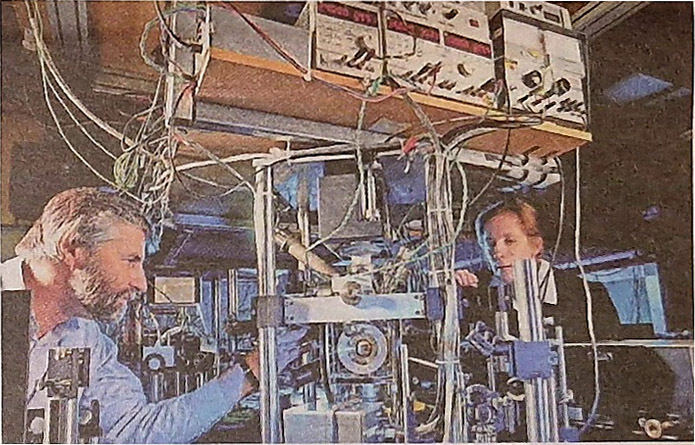
Because the caesium clock runs at microwave frequencies, the time of each ‘tick’ is too long, or varies just a bit too much, to measure some of the relativistic effects, but now the clock is being adapted  to use Ytterbium atoms, which vibrate at a higher frequency such that they need be excited (made to vibrate) with a laser.

This is so precise (a better word than accurate) that physicists at NPL (where Essen did his revolutionary work) are now able to detect changes in the height of the earth’s crust under their lab as the moon orbits.  I can’t imagine that Essen, or even Einstein, would have imagined that!

 A Times  article explains that Physicists are working on calibrating their ytterbium clocks so that in future the length of a second will be defined in terms of the number of vibrations of an ytterbium atom.

Unfortunately journalists then have to betray themselves with statements like ‘it would have lost barely a second in the lifetime of the universe’.  I presume that they are referring to the stability of the clock, because as we have just learned, if you take it up in an airliner, it will lose quite a bit of time compared with the one in the lab!

*The spacetime continuum

Special Relativity says that time is dependent on the speed of the observer because space and time are not independent, but part of the same 4-dimensional continuum. Einstein’s General Relativity came a decade later in 1915.  It added the further effect of Gravity, giving rise to the famous equation E = mc².  In the simplest of terms, one implication of General Relativity is that mass causes curvature of the spacetime continuum, which we observe as Gravity.  This effect was observed four years later during a total eclipse, when astronomers saw that the light of a bright cluster of stars was being bent around the sun, causing the apparent position of the stars in the sky to be slightly shifted.  This ‘gravitational lensing’ is now used to study many cosmological effects.

Is Gravity actually just another aspect of the Quantum Electromagnetic Field?

A recent article in ‘New Scientist’ by Oxford University physicist Vlatko Vedral (issue 3567, 1st Nov 2025) titled ‘No Space, No time, No Particles’  looks at Werner Heisenberg’s flash of genius in 1925 when he sketched out the basics of Quantum Mechanics. thereby managing to tie physicists up in knots for the next 100 years!

Vedral states that Relativity and Quantum theory are the two pillars of modern physics.  The essence of Quantum Theory is that reality is divided into chunks at the most fundamental level. A particle is changed by ‘observation’:  before observation,  it is described by a ‘fuzzy’ wave function, but after observation, it collapses to a specific value.  This creates an anomaly, because to an observer, the particle has a specific value, whilst to the non-observer, it is still a fuzzy wave function.  He basically argues that the wave function doesn’t collapse on observation and that there is no need for observers anyway.

To connect Relativity and Quantum Mechanics would mean that Gravity would need to be quantised too. He argues that in fact it is the electromagnetic field that holds all matter together, and therefore the spacetime continuum is not fundamental.  Gravity is just another quantum field.

Maybe he’s right, but I have no idea where that leads us!

A clock regulator

St Andrews’, Cobham, Surrey

I’ve not blogged about one important clock that I look after – namely the church tower clock at Cobham, Surrey.  The clock is a so-called ‘flat-bed’  made by Thwaites and Reed of London in 1896.  It uses the tower bells for a ‘ting-tang’ strike on the quarters and it strikes the hour on the tenor (heaviest) bell. The mechanism is shown at the top of this post.  It rests on steel I-beams at the level of the clock dial in the photo of the tower.

It used to be wound by the bell-ringers once every week, which meant ascending two vertical ladders, one an ancient timber ladder fixed to the wall, through a trap-door and up another a steel-rung free-standing ladder and trap door;  then winding three heavy weights up through the whole height of the tower, a job requiring dedication and effort.

The rear of the clock, showing the winding motors
The rear of the clock, showing the winding motors.

Probably around 1975, when the bells were augmented from six to eight, electric winding was added. No doubt, some of the ringers were starting to feel their age! One motor raises a weight a short distance to keep the pendulum going even during a power failure; two other motors drive the quarter and hour striking chains directly.  There is an electronic control box for the striking mechanisms, although I’m not sure what it does. It doesn’t control the number of strikes as this still uses the original mechanical system linked to the position of the clock hands. I suspect that it silences the chimes at night, although I’ve not been there to find out.

Some of the eight tower bells

However, more than a year ago, just after I became a ringer at Cobham, the clock kept stopping. The clock makers took ages to attend and restart the clock.  After a month or so, it stopped again.  This happened several times, and the church authorities were getting complaints that the clock was never right.

At first the clockmakers tried to blame various things such as a fault in the church electrical supply, but I pointed out that the clock always stopped at 53 minutes past the hour, although not always the same hour, and that there didn’t appear to be a fault in the drive to the clock hands.

The pendulum and catcher plate

The clockmaker explained the operation of the regulator mechanism fitted to the pendulum. The pendulum is about 7 feet (2.1 metres) long, so it is probably designed to have a period of 3 seconds. The idea is that the pendulum is set to gain very slightly and the position of the hour hand is checked by a tag that should pass a light sensor at 53 minutes past the hour. If the clock is fast, the regulator has a magnetic arm that extends to hold the pendulum stationary for a few seconds and then releases it so that the clock is correct when the hour is struck.

Identifying the problem

After much persuasion, the clockmakers replaced the whole regulator system, but this did not cure the problem.  Then I noticed that the catcher plate on the pendulum had twisted slightly so that it was no longer directly aligned with the magnetic arm.  The catcher plate is held onto the very heavy cast-iron pendulum bob with plastic cable ties. Since we’d been having unusually hot weather, it is likely that the cable ties were able to stretch slightly, allowing the catcher plate to loosen and slip a tiny amount round the bob. The more off-centre it became, the greater the tendency to slip until the catcher, instead of stopping the pendulum, merely  impeded it until the swing was insufficient to maintain the drive.

I discovered that by carefully using a heavy spanner to tap on the catcher plate support, I was able to re-align it exactly and the clock is now keeping time perfectly!  I will probably now glue the catcher plate into place with heavy-duty construction adhesive.

The tower bells

I should briefly mention the bells themselves.  There are eight bells: two date from the mid 18th century, with the most recent being cast in 1979 when the ring of six was augmented to a ring of eight. The heaviest bell (the Tenor) was cast in 1902.  It has a diameter at the mouth of 38 inches (97 cm), weighs half a ton and is tuned to the note of G.  There is much more about the bells and ringing on our sister website.

The bells are hung for ‘full circle’ change ringing in a steel and cast iron frame mounted above the clock and they are rung from the ground floor, so they have what is called a ‘long draught’ of about 60 feet.

In the photo above, they are in the ‘down’ position and you can see the blue-painted clapper hanging free in the centre of the bell. There are separate clock hammers which aren’t shown in the photograph.

A model bell up at handstroke

In this photo of a model bell, the bell is raised or ‘up’ for change-ringing.

The bells are raised and lowered by using the rope to swing them higher and higher.  Ringers try to do this whilst ringing the bells in order, a skill that is particularly difficult to acquire.

The clock can only strike the bells when in the down position, so they must be lowered from the ‘up’ position after each ringing session so that the clock can strike.  This also requires considerable skill and if a tower doesn’t have a clock, there is quite a temptation to leave the bells ‘up’, but this is generally frowned upon as it would then be very dangerous for anyone go amongst the bells.


Essen’s work changed the basis of our whole system of measurement

A Universal Constant

Although the speed of light is a Universal Constant, fixed throughout the cosmos, the units that we use to measure it – the metre and the second – are entirely artificial.   In Napoleonic times, scientists tried to improve the accuracy and reliability of mediaeval weights and measures by finding rational,  scientific definitions of the fundamental units. This included defining the metre as one ten-millionth of the distance from the North Pole to the Equator, passing through Paris: obviously this would be pretty difficult to measure with certainty, so it was indirectly measured from the length of a platinum bar stored in a vault in Paris, that was said to be equal to that value.  Obviously, the metal bar had to be kept pretty safe from damage or contamination: furthermore metal expands with temperature so that had to be controlled too. Not very satisfactory for a fundamental international standard.

That is bad enough, but the second is arbitrary too.  Historically defined as 186400 of a day – a day being the time between noon on successive days –  the big problem is that days are not equal in length, due to the effect of the earth orbiting around the sun, and other perturbations in the earth’s rotation. With an accurate clock, you can measure the length of each day and take an average value.  Or to be more accurate, you can measure the length of a year and make the second an agreed fraction of that time.

Fundamental properties of matter

But neither of these are based on any fundamental property of matter and with a sufficiently accurate clock, we find that they are not entirely constant.

So if we say that the speed of light is, say, 299,792,458 metres per second, we presume that we know exactly and incontrovertibly the length of a metre and of a second.

The importance of the second

The measurement of time is fundamental to the measurement of most of our physical quantities – and the second has become a basis of most of our fundamental measurement units.

For example, the present standard definitions of distance (the metre), weight (the kilogram), electrical current (the ampere), temperature (the kelvin) and luminous intensity (the candela),  all depend on the second. The only base unit whose definition does not depend on the second is the mole  (the amount of a substance, derived from the word molecule). Of the 22 named derived units, only radian and steradian (measurements of angle) do not depend on the second.

So it is rather important that we know exactly, accurately and  repeatably, how long a second is.

Thus it is pretty amazing that the absolute length of a second was not internationally agreed until 1983!  And this agreement relied on Louis Essen‘s work: hence, it is astonishing that his name is almost completely unknown.

Essen’s wartime work

Louis Essen’s wartime work driven by the requirement to measure the frequency of radar and thus radio waves accurately.  After completing his degree in Physics,  he joined the NPL (the UK’s National Physical Laboratory) in 1929, and began working on measurements of frequency, leading to the development of the quartz ring clock in 1938.  A ring of quartz crystal was induced to vibrate using  an oscillating electric field and the vibrations were counted by using thermionic valves to subdivide the vibration into measurable steps which were counted to measure time.

This quartz clock was far more reliable than anything else at the time and became widely used as a time standard in observatories. It was the first device accurate enough to discover minute variations in the Earth’s speed of rotation; prior to this astronomers thought that the Earth rotated at a completely constant speed, and they divided the resulting length of day into 86,400 seconds.

Astronomers already knew that the length of a day – the time between noon on successive days (as distinct from the length of daylight) does vary throughout the year due to the tilt of the earth relative to its orbit around the sun, so International Astronomical Union decided to adopt a definition of the second as the basic unit of time, measured as a fraction of the time taken for the earth to complete one orbit of the sun (i.e. one year).

Essen ridiculed this as being even harder to measure correctly than averaging the earth’s rate of rotation, which made him rather unpopular.

Using his quartz clock to measure the frequency of his radio waves, and knowing their wavelength from the dimensions of his resonant cavity, Essen made new measurements of the speed of light which were about 15 km/s higher than the standard accepted at the time, the simple formula being c = fλ, where
c is the speed of light, f is the frequency of the wave and λ is the wavelength of the wave.

The connection between the speed of light and the second

So, how are the speed of light and the length of a second  so fundamentally connected?

We have noted that the metre was defined in Napoleonic times as the length of a platinum rod kept in a vault in Paris.  Although scientists had come up with a rationale for the length of this rod, it relied on some assumptions of dubious validity.  Likewise for the second.  But if you fix one of these values, then since the speed of light is universal, you can fix the other one, and thereby almost everything else.

The Atomic Clock

Essen designed an Atomic Clock, which used the resonance  of  Caesium atoms to further stabilise his quartz ring resonators which were already being used as a time reference in observatories.   The following describes the principle of such a clock – actually making one was at the extreme edge of physics at the time, in 1953 to 1955.

Why use Caesium?
Caesium is an ‘alkali’ metal very similar to potassium, and sets on fire when put in water, or even in air, so it is never found naturally in its metallic state.  There is only one stable isotope, Caesium 133.  [Caesium 137 is a radioactive isotope obtained from nuclear reactors and used in medical treatments,]

We are all aware of the light emitted by atoms when they change energy states – the most common example is the familiar orange glow of the sodium vapour street lamp.  In a sodium lamp, an electrical discharge through a tube containing metallic sodium causes it to heat and emit its characteristic ‘D’ lines of monochrome light.  We are also familiar with ‘neon’ tubes that emit light of various other colours.

The colour of the light depends on the atoms being used, and more correctly we should say ‘electromagnetic radiation’ or ‘photons’ because the frequency of the radiation emitted by the atom can theoretically be anywhere within the electromagnetic spectrum.

Essen chose Caesium firstly because as an alkali metal like sodium or potassium,  it only has one electron in its outer shell, so it emits a simple, single frequency rather than a range of frequencies.  When the atom is excited (energised) this electron develops a ‘spin’ (I suspect this term is a conceptualisation of a complex phenomenon) which causes it to be deflected by magnetic fields. The spin can be in the same direction as the spin of the atom’s nucleus, or in the opposite direction, and these represent two different energy states, and causing them to be deflected in opposite directions by a magnet.  When the electron changes energy state, it absorbs or emits a photon of an exact frequency that is characteristic of the particular atom.      The frequency absorbed or emitted by Caesium is  9,192,631,770 Hz, which is at the upper limit of what Essen’s wartime radar and speed-of-light apparatus could measure. So in fact it isn’t within the visible spectrum (where it was not possible to measure frequency at the time).

How the atomic clock worked
The atomic ‘clock’ worked in quite an obscure fashion.  Essen heated caesium atoms in an ‘oven’ contained within in a tube about 1.5 m long holding a total vacuum.  The atoms came out of a slit in the oven and passed down the tube between the poles of a magnet. This focussed the spinning electrons towards a narrow slit in the centre of the apparatus.  The electrons that pass through the slit then pass though another magnet which continues to deflect them away from the centre of the apparatus, where they are lost.

But when an oscillating electromagnetic (radio) field is applied to the space between the magnets at the exact resonance frequency of the electrons ( 9,192,631,770 Hz), their direction of spin reverses!

This means that when they pass through the second magnet, instead of bending further away, they bend back towards the centre of the tube and strike a detecting target made from a heated tungsten wire.  This causes charged atoms to be released from the wire and attracted to a detector, creating an electrical current.  This current is very small, but when greatly amplified, changes in the current can be detected, which increases by about 10 % when resonance occurs.

Now, the radio wave of exactly 9,192,631,770 Hz is generated from a quartz ring oscillator.  The oscillator runs at 5.00688 MHz, which when multiplied by 1836 gives the Caesium frequency.

The smallest drift of the oscillator frequency would be multiplied by almost 2000 times and detected by a change in the beam current of the clock apparatus which was used to correct the oscillator.  The oscillator could be used to run a normal quartz clock and thus to display the passage of time.  With some refinement, such a clock was accurate to 1 part in 10 million million, which is 10,000 times more accurate than astronomical time.

Ramifications
This accuracy has had many fundamental and far-reaching ramifications.  Not the least of these has been the abandonment of solar time or sidereal time as a reference for the second.  Since one of the raisons d’être for observatories has been the measurement and maintenance of time standards, it met with much resistance before being accepted and contributed further to Essen’s unpopularity.

Problems with Einstein’s Relativity

Einstein had said the since the speed of light was not affected by speed of travel, the logical consequence of this was that  passage of time must be affected by speed of travel.  This seemed illogical to Essen (perhaps because he could not believe that the rate of vibration of atoms was affected by speed of travel) argued that Einstein was wrong about the speed of travel affecting time, but in 1971 scientists sent three caesium clocks around the world in jet airliners, and found that they were showing a time slower than a clock that had been stationary in their lab.  Sadly for Essen, his own clock proved his assertion to be wrong!

The speed at which time passes does depend on how fast you are moving, after all!

But this astonishing prediction could not have been proven without Essen’s own work!

[I hope to refine this article in a while]

Louis Essen, the Speed of Light and Atomic Clocks

Many of my blogs are either about bell-ringing or about clocks.  I had a serendipitous moment yesterday when I visited a bell-ringer whose father in law was Louis Essen.  Never heard of him? Neither had I, but a clock on my friend’s  mantelpiece caught my eye because it bore the bold blue letters NPL, which I recognised as the logo of the (UK) National Physical Laboratory.

To my utter amazement, he told me that in 1955, Louis Essen, his wife’s father, working at the NPL, developed the first practical atomic clock by using the resonance of caesium atoms. The first part of my story is to explain how and why Louis Essen got to do this.

During the war years, Essen was working on improving the accuracy of measurement of the ultra high frequencies used for radar, which have wavelengths measured in centimetres rather than the kilometres used by some radio stations.  Radio waves travel at the speed of light, and the speed of light is equal to the wavelength of the radio or light wave multiplied by its frequency. Or, looking at it another way, the speed of light divided by the wavelength gives the frequency of the radio wave.

One of the problems in the war years was to measure the frequency of the radar signals.  Essen used a cavity resonator (with similarities to a modern microwave oven!) to generate the radio waves: if he knew the size of the cavity, this gave him the wavelength, and hence the frequency could be calculated by dividing the speed of light by the wavelength.

The speed of light is a fundamental property of the Universe – when in a vacuum, it is constant throughout the Universe and is independent of the speed at which the observer is travelling (remembering that when we are sitting still in a chair looking at our computer screens we are still whizzing through the Universe at zillions of miles an hour).  [The constancy of the speed of light is, of course, a principle of Einstein’s Theory of Special Relativity].

So, it is pretty important to know how fast light does travel.  To the old astronomers, it seemed infinitely fast, but by the 17th century, a Danish astronomer discovered by observing the eclipses of Jupiter’s moons, that it had a finite speed.

Essen built  electromagnetic ‘cavity resonators’ to extremely accurate dimensions and measured the frequency of the radio wave that they generated.  Now it is a principle of a resonant cavity that they will vibrate in different ‘modes’ and that the wavelengths of each mode should be simple integer fractions of each other (such as a half, a third and so on), and their frequencies should then be corresponding simple integer multiples of each other.

But when he divided the wavelengths (which he knew from the dimensions of the cavity) into the speed of light, he didn’t get the corresponding frequency multiples.

Something was wrong! But what? Ultimately, in 1950, he concluded that astronomers, using optical measurements, had got the speed of light too low by about 15 km/s !  [He measured it as 299792. 5±1.0 km/s] This was most unpalatable to science, because astronomers had only just agreed a new (and hopefully more accurate) value for the speed of light.  Obviously, it was necessary to shoot the messenger and so he suffered fierce criticism and disbelief, even amongst his colleagues.  His boss told the scientific establishment that Louis was a clever chap and would get the right answer as soon as he perfected his apparatus!!!

In fact, in 1983, the international standard for the speed of light was agreed to be 299,792.458 km/s, so Essen was right after all.  The uncertainty in his result was largely due to uncertainty in the length of the metre!

What has this got to do with atomic clocks? Hopefully we will get to that in my next blog

Updating an old mantel clock

My father had what I assume was a bit of a family heirloom – a small art nouveau wooden mantel clock.  It had never worked. As a kid, I fiddled around to repair it – I even fitted a new clockwork movement and a music box to play hourly tunes – but it was never reliable.

The updated mantel clock

It annoyed visitors to the house because it never showed the right time – well, I suppose it was right twice a day – and it had become tarnished and dull.  Nothing but an embarrassment.

Having had some success fixing a couple of other clocks recently, I decided to investigate putting in a quartz movement.  The first step was to take it apart and I was quite amused by all the bodges I’d made to fit a new clockwork movement.

I wanted to retain the original hands, but the clockwork drive was fairly compact, made from steel and brass with thin shafts. Especially important was that the drive shafts went through a small hole in a filigree panel inset into the enamel dial: I could not risk any drilling to enlarge the holes, although these were far too small to take a standard quartz movement.

So, was my project even possible?  Was there any sort of quartz movement could I use?  A good old Google search revealed the existence of a ‘Round UTS microshaft carriage clock movement’ with a 10 mm long shaft for less than £10.

This has an hour shaft 3.5mm mm in diameter and a minute shaft 2.0mm diameter. This is about two-thirds the  diameter of the standard movement and a very close match to the original hands which I was keen to retain.  Moreover, it would easily fit through the 5 mm hole in the clock dial.

There were a couple of problems, though.  Although the movement was fixed by a brass collet that screwed into the front of the movement, this was intended for a thicker dial, so I had to file it down to about half its length so that it would pull up tight.  Secondly, the collet had to fit into the brass backing plate so I had to enlarge the hole in the backing plate and drill a recess so that the collet would screw down flush with the plate, so that the dial could lie flush against it.  This left just enough of the rather short 10 mm shaft protruding through the dial so I could fit the hands sufficiently far out to avoid scraping the dial.  Unfortunately, in enlarging the hole in the backing place to take the collet, I must have gone very slightly off-centre (I only have a hand-held drill).  Luckily it is only noticeable to the keen-eyed engineer!

My final problem was fitting this all securely inside the the brass cylinder that housed the original clockwork. I wanted to use the original fixing holes and screws, but the different depth of movement wouldn’t quite allow this and I reluctantly had to drill a couple of extra holes for the fixing screws.

The Quartz movement
The Quartz movement

The case had got a bit damaged with time: the original glue had dried out causing some moulding around the base to fall off. Although I had kept it carefully, a small piece is missing – I will try my wood-working skills to make a replacement sometime.

Also, the brasswork was tarnished and there is a chip in the bevelled glass. The glass seems to have been heat-shrunk into place and it would be quick difficult to get it out, so I’ll probably leave that.

The Brass Dome
The Brass Dome

The brass dome that keeps dust out of the back of the movement was so corroded that I thought it might be brass-plated steel, but testing with a magnet didn’t support this idea, so I soaked it in Viakal (which seems to be weaker than in the old days) and it has come up quite nicely.  Still a bit pitted but I think it has come character.

Updating a quartz carriage clock

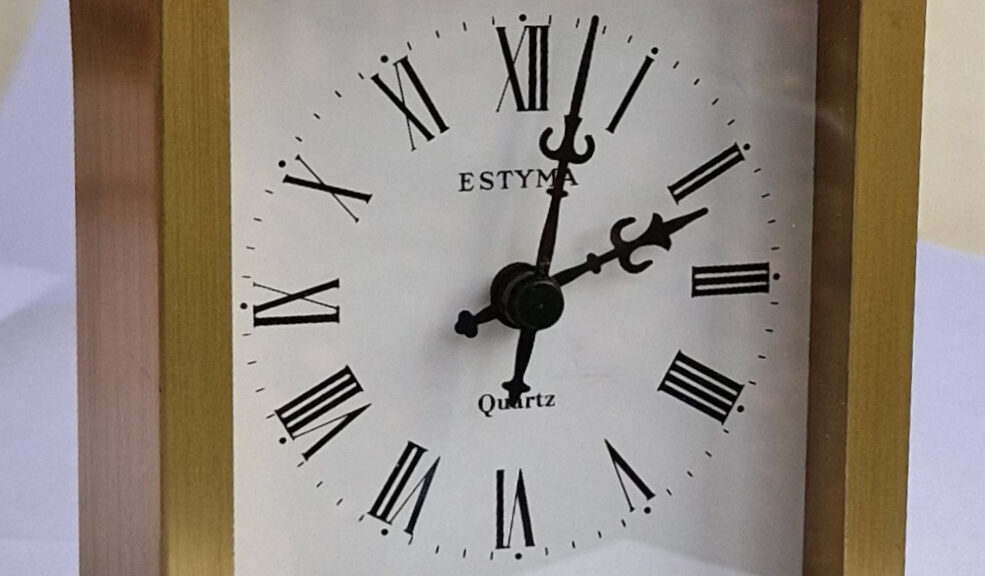
My partner had a badly-neglected ‘Estyma’ brass carriage clock with a quartz movement that didn’t work, but had sentimental value. She thought it was about 45 years old and it hadn’t worked for some decades.  The movement was roughly the same size of square plastic case as modern ones, but much deeper and using a large C-sized battery.

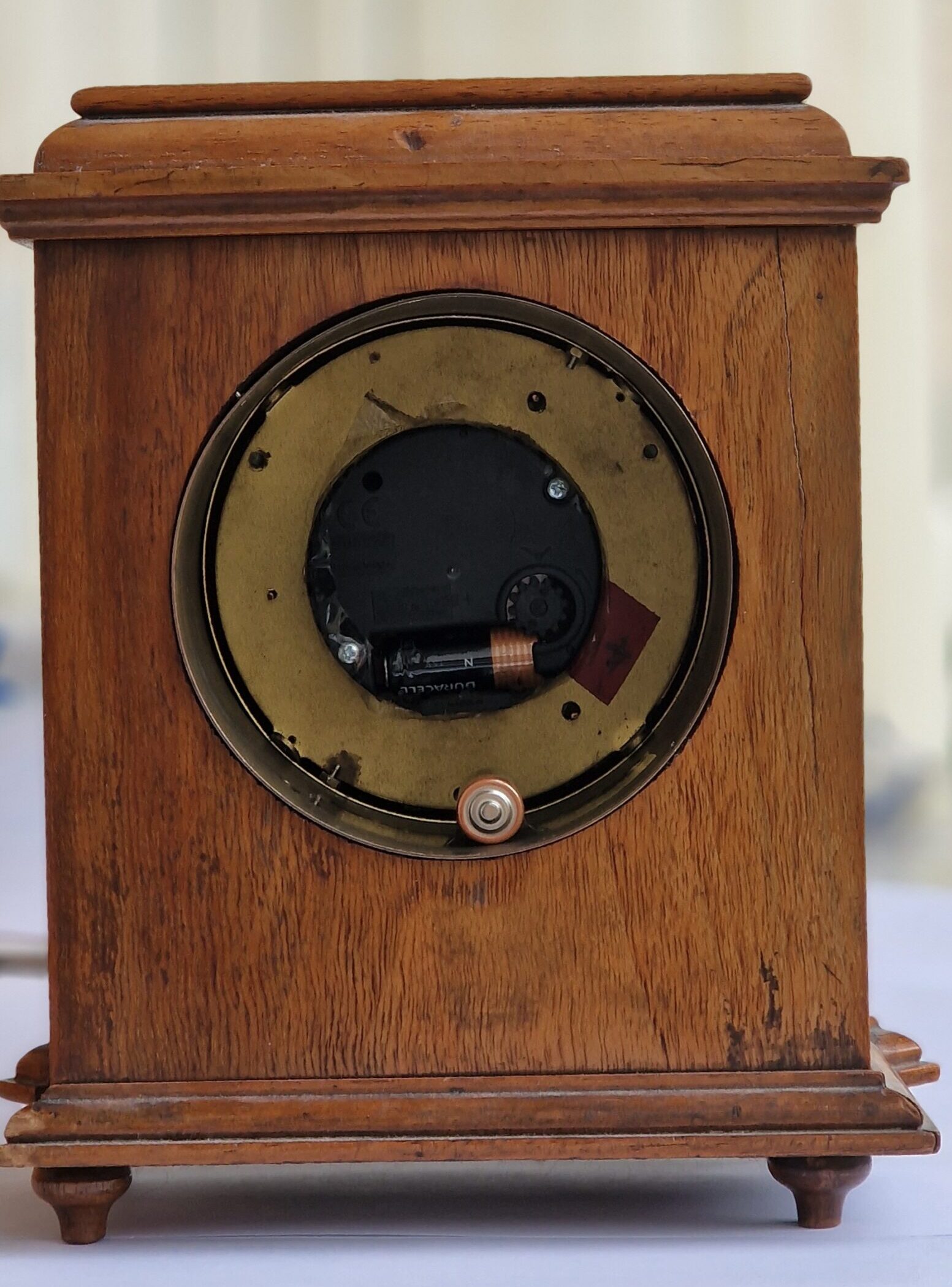
Back of original (40-yr old) quartz movement
Disassembly

I managed to disassemble the clock (it came into dozens of parts) but I couldn’t see how the movement was fixed in, until I realised that between the white clock face and the backing plate there was a brass collet that screwed into a recess in the front of the movement.  But the clock face was glued onto the backing plate, covering the collet, and I didn’t want to pry them apart as this risked bending  the face plate, which would have ruined it. I spoke to a helpful clock parts supplier who suggested that I could soften the glue with lighter fuel.  I was rather dubious but went into a local vape shop and bought a can.  I gently pried a small gap between the plates and let the fluid seep into the gap.  To my amazement, the glue started to soften and by applying more lighter fuel, I got them apart without any bending.  The plates were actually secured with some sort of double-sided adhesive tape.

Choosing a replacement movement
Front of original movement showing hand shafts

I measured the shaft diameters for the minute and hour hands with my vernier calipers (which I thought were expensive when I bought them, but have proved to be invaluable for measuring circular objects) at 3.4/3.5 mm and 5.1 mm respectively. Following some searching, I found a  new quartz movement fixed with a screw-in collet at the front, with a precise fit for the hands from a seller on Ebay called ‘clocks-uk’.  The only other decision was on the shaft length: the original was 12 mm long but only 11 and 13 mm were available, so I opted for the 13 mm, as I could always shim any excess length with a rubber washer. In the end, this was unnecessary.  The only issue was the cover for the seconds pin.  The pin was deeply recessed on the old movement, so the cover had a long fixing lug that fitted inside the minute hand shaft. I had to cut that off and super-glue it over the minute hand fixing hole. It doesn’t show.

Front of refurbished clock
Rear of refurbished clock


After I spent several hours cleaning the brasswork (I find Viakal limescale remover is excellent for removing the tarnish from brass)  it all went back together beautifully and my partner is delighted.

Radio-Controlled MSF clock

I have been asked to repair a clock with a radio-controlled MSF quartz movement because it keeps trying to reset itself even when it is showing the correct time.

Accordingly, I have decided to dig into the technology a little.  The National Physical Laboratory is responsible for the UK time standard which it maintains via some Caesium ‘Atomic Clocks’.

I won’t go into how an atomic clock works, except to say that caesium atoms placed in a special ‘oven’ can be made to vibrate at an extremely consistent frequency, i.e. number of vibrations per second.  By counting the vibrations, you can measure the interval between two events, and a second is now defined as a particular number of vibrations of the atom.  This is regarded as one of the most fundamental units of measurement.

This allows us to measure the time between noon on successive days. As discussed elsewhere in these blogs, this varies slightly throughout the year and from year to year, due to complex astronomical factors. In the Victorian era, it was decided to average these fluctuations to give a consistent length of 24 hours (86,400 seconds) to each day, and this was formerly known as Greenwich Mean Time or GMT.  Noon was the instant that the sun was at its highest elevation in the sky above Greenwich, but averaged throughout the year.  Owing to perhaps internationalistic concerns, it was decided to rename GMT as UTC – Universal Coordinated Time (presumably the word order is different because it was defined in French!)

So the atomic clocks at the NPL are calibrated to show UTC. In fact, to keep UTC in synch with the sun, it is occasionally necessary to add a second to the length of the day from year to year.

There has to be a way of allowing people to set their clocks to the universal time.  Originally, you had to take your chronometer to Greenwich and to set it from the reference clock which is (still) at the gate there.  Then there was (and still is) the Greenwich time signal which is broadcast by various radio stations, although I’ve noticed much less so nowadays.  The reason is that digital radios have built in processing delays, so the pips can often be randomly delayed by a number of seconds, which is not good for an accurate clock.

The solution was to build a huge special radio station at Anthorn, near Carlisle, on the site of a wartime aerodrome.  This houses an atomic clock synchronised to UTC (probably it defines UTC!) and broadcasts a time signal on a frequency of 60 kHz.  This is an extremely low frequency for a radio signal – very long wave length of 5 km!!  I won’t go into how the aerial is matched to this frequency as it needs an understanding of radio technology.

The 60 kHz carrier acts as a national frequency standard and it is modulated by on-off keying to transmit the time information, which can be decoded using standard software. The transmission power is 17 kW, which produces a useable signal throughout northern and western Europe.

The call-sign is MSF which is not an abbreviation of anything in particular, although it is sometimes called ‘Master Standard Frequency’.

Some radio controlled  quartz clocks are use the German DCF77 signal, which is said to be useable at up to 2000 km distance.

So radio controlled quartz clock movements for use in the UK will be designated as MSF or DCF.  However, it should be noted that German time is 1 hour ahead of UK time, and summer time (daylight saving time) corrections whilst currently synchronised across Europe, may not remain so.  It is therefore advisable to ensure that when you buy a movement for use in the UK, you ensure it is designed to receive MSF.

A lot of the quartz movements are designated UTS, which puzzled me for a while – I wondered if it was some sort of manufacturing standard, but it now seems that it is a German brand name of clock.

An external garden clock

I should apologise to anyone who has been wondering where I’ve gone. I’ve been busy on dozens of DIY jobs, including gardening. I don’t like wearing my good watch when doing these, as it could get damaged or lost, but then I don’t know the time – and anyone who has read this blog will know that I’m a little obsessive about time (perhaps because I’m often late).

I’ve been wanting a nice clock on the back wall of the house for years.  In my imagination, this would be a lovely old mechanical turret clock, but I need to be realistic.  So I recently searched the internet and bought the one shown at the top of this post. I got it on Amazon (Trendsetters brand) for GBP60 including delivery, quite a bargain as there is no way you could even buy the materials for that price. The dial is 80 cm across, so it is big, though not as big as the church clock that I look after.

I am delighted with it, particularly the minute chapter ring with the diamond hour markers, and the fact that the number 4 is marked in the correct IIII fashion, rather than IV as used on many of these ‘antique’ clocks.  I was slightly disappointed that the hands where thin anodised (silver) aluminium, rather than gold, so I bought a tin of metallic ‘gold’ spray paint, which has worked very well.

It is supposed to be weatherproof, but in fact it is driven by a conventional quartz movement with a plastic cover, housed in a round metal casing in the centre of the clock which is open at the back.  Since the clock is open to the elements, I don’t think this counts a ‘weatherproof’ – a short, sharp rain shower left raindrops all over the casing and frame.  So I put a liberal dollop of grease around the shaft, in the hope that this will reduce water ingress and consequent rusting.  Of course, you can’t prevent it entirely, if only because the warming and cooling action of the sun and wind will suck moist air in, which will condense at night.  The inside of the mechanism is mainly nylon, but there are some metal parts which are probably plated steel, so I can imagine needing to replace the movement after a while.

My main concern with the aluminium hands is that they are very thin and light, as they need to be for the mechanism to move them, but the hour hand had come slightly loose in transport as it is only a push fit on the shaft.  If you don’t get it on exactly square, it will either foul the dial or the minute hand.  The minute hand had been bent well out to avoid this (or perhaps when I removed the packaging), but this looked horrible when viewed from below.  I eventually got the hands straight and with the minimum of clearance to avoid them tangling as they passed each other.  But they do vibrate at right angles to the dial when there is a strong gust of wind, and I have a concern that if this happens when they are passing each other, again they could tangle.  Only time will tell.

However I can reach the clock from the window above, so servicing will not be an issue.

An Astronomical Clock

I’m wanting a new project now that I’ve gained some confidence with the Moon Clock.  I wrote some long while ago about Astronomical Clocks.  Observations of celestial bodies were crucial to the ancients, so that they could know the changing of the seasons and when the moon would be lighting up the night sky.  They knew about the major planets and just as the seasons affected life, they predicted other events from observations of the night sky.

At one time, astronomy and astrology were two sides of the same coin.  The stars in the night sky were grouped into ‘constellations’ given names of mythical figures, and if you were born at the time a certain planet was ‘passing through’ [i.e. orbiting past] a certain constellation, this could predict your nature and future.

The ‘ephemerides’ program that I used for the moon clock can calculate the position of all the major planets (and many less-obvious celestial bodies) at any given time.  This is by no means a trivial task, as it is affected by the relative tilt of the orbits of the earth and planets, and the different time it takes for each planet to orbit the sun, and of course the time of day, season of the year and location of an earth-bound observer.

These factors make it difficult for an inexperienced observer to locate the planets – indeed they are not always visible, since this needs them to be above the horizon when it is dark, and just like the moon, this may not be at ‘social hours’.

So I am thinking how to make an astronomical clock that will show the altitude (height above the horizon) and azimuth (compass direction) of each of the major planets.  Each planet should have these two values shown on a single dial with two concentric hands.  However, the two values don’t progress in the simple orderly manner of the moon – whilst normally they orbit east to west across the sky, sometimes they make a ‘retrograde motion’ – they appear to orbit in the opposite direction.  This is only an optical illusion caused when the earth and the other planet pass each other in their orbits, but is hopeless for a hand driven by a clock motor, as this can only go one way.

I don’t have the clockmaking skills to create concentric gearing.  The altitude can be managed with a dial that has 90 degrees at the top and 0 degrees at the 3 o’clock and 9 o’ clock positions, and -90 degrees at the bottom.  So I am wondering if it might be possible to take the central ‘seconds hand’ spindle out of a clock movement and to put a two-phase stepper motor with a very long spindle through the clock movement.  This can be used to show the azimuth and can go in either direction.  Much bodging will be needed, but could be quite good.

A bipolar stepper motor showing internal construction and drive shaft

Food for thought, but I can see I will be getting into trouble for being ‘too distant’, ‘head in clouds’, ‘somewhere else’ – and all this would be absolutely true – my mind will be literally ‘on another planet’!

Moon Clock – declared final?

I’ve just reinstalled the moon clock, after storing it away for a year during my renovations.   And it wasn’t working well.  Basically, the hands would stutter and ‘fibrillate’, meaning it just wasn’t keeping time.  I concluded that they were sticking, so got some proper watch oil [having been told by a clockmaker that bicycle oil was ruination for a clock, because it turns treacly after some time] and took the quartz movements apart.  They seemed to be quite clean, but there was no oil, perhaps the plastic components have little friction, but having got that far, I thought I would try some oil.  I made an oiler out of a piece of fairly thin garden wire, flattened at the end, and used it to carefully apply tiny drops of oil on the pivots and gears.

Testing the motors on the bench, they worked like a charm.  But when I assembled the whole thing, they would rotate beautifully but then start fibrillating and even running backwards!

I slowed the pulsing rate down but this didn’t help.  Then I realised that in a certain place, the long seconds hand touched the glass!   This caused it to spring backwards and then forwards repeatedly.  The answer was straightforward – to bend the seconds hand very slightly away from the glass, but not so far that it tangled with the other hands.  The moon phase disc also seemed to touch the edges of its housing at one point due to being very slightly eccentric.  I was able to pare away a very fine sliver from the edge.

Now, touch wood, it is keeping time beautifully. It was satisfying to watch it at moonrise this morning – the time hand clicked past the rise-time hand, the moonlight came on and the azimuth hand spun to the correct position in a fabulous little routine.  But it needs a bit more ‘soak testing’ before I’m sure.

When I have the energy, I will write this up into a complete project.  In the meantime, I have a wind-up clock to get working again.